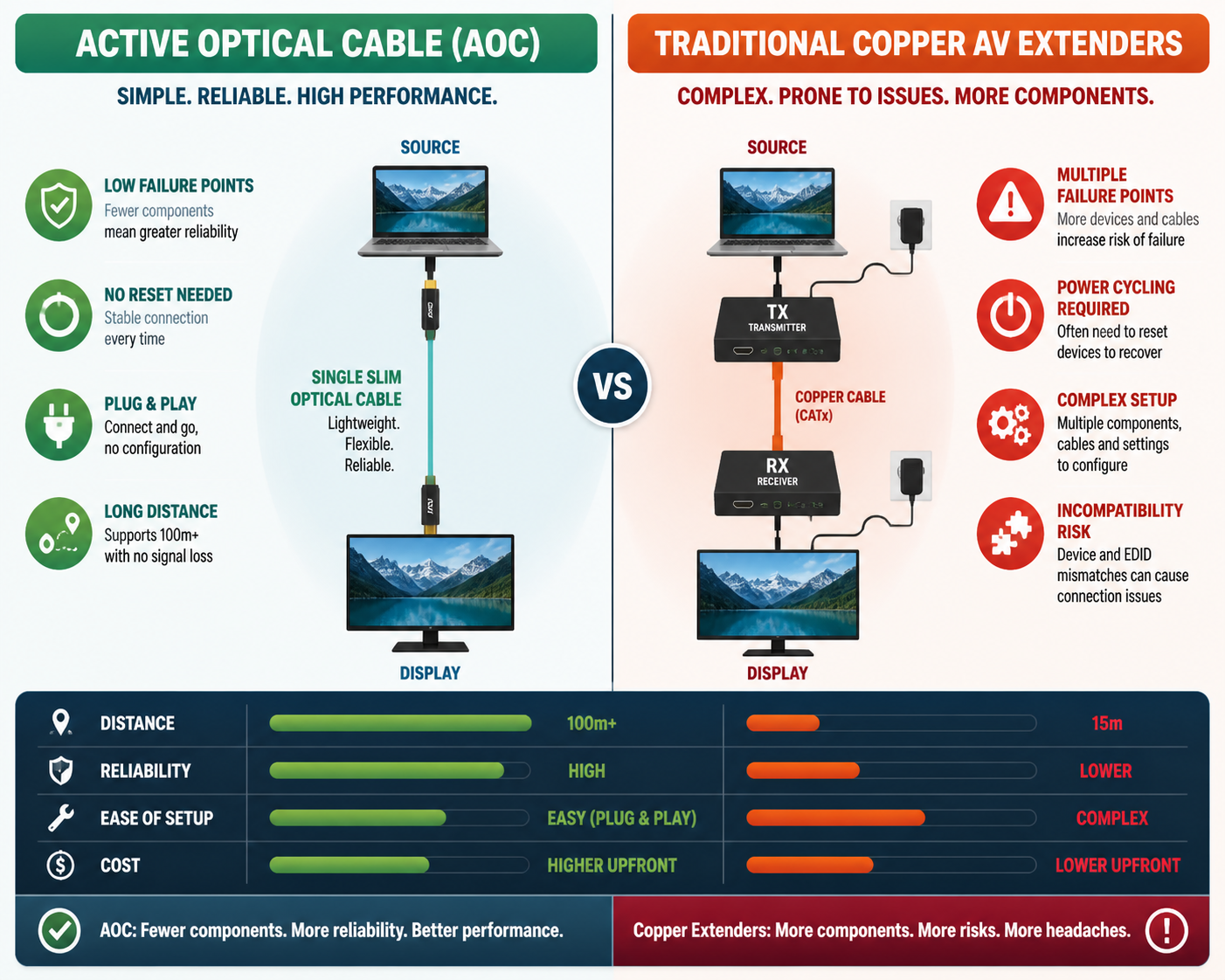
AOC vs Traditional AV Extenders
AOC: Works exactly like a standard passive cable — plug and play. No configuration needed. Can connect directly to standard HDMI splitters and switches just like a normal cable.
Traditional Extender: Requires matching transmitter and receiver units, proper Ethernet cable termination (straight-through vs crossover often matters), and power sources at both ends. If a copper extender solution malfunctions, a technician has to power cycle the transmitter and/or receiver.
With AOC: "Active Optical Cables make this type of setup much easier by connecting directly to a standard HDMI splitter or switch just like a normal passive cable — the only points of failure being between the splitter/switch ports and the connected AOCs."
With Copper Extenders: Requires either a specialized extender with built-in splitter/switch + multiple receivers, OR combining standard splitters with multiple extender kits — "much higher risk of incompatibility problems."

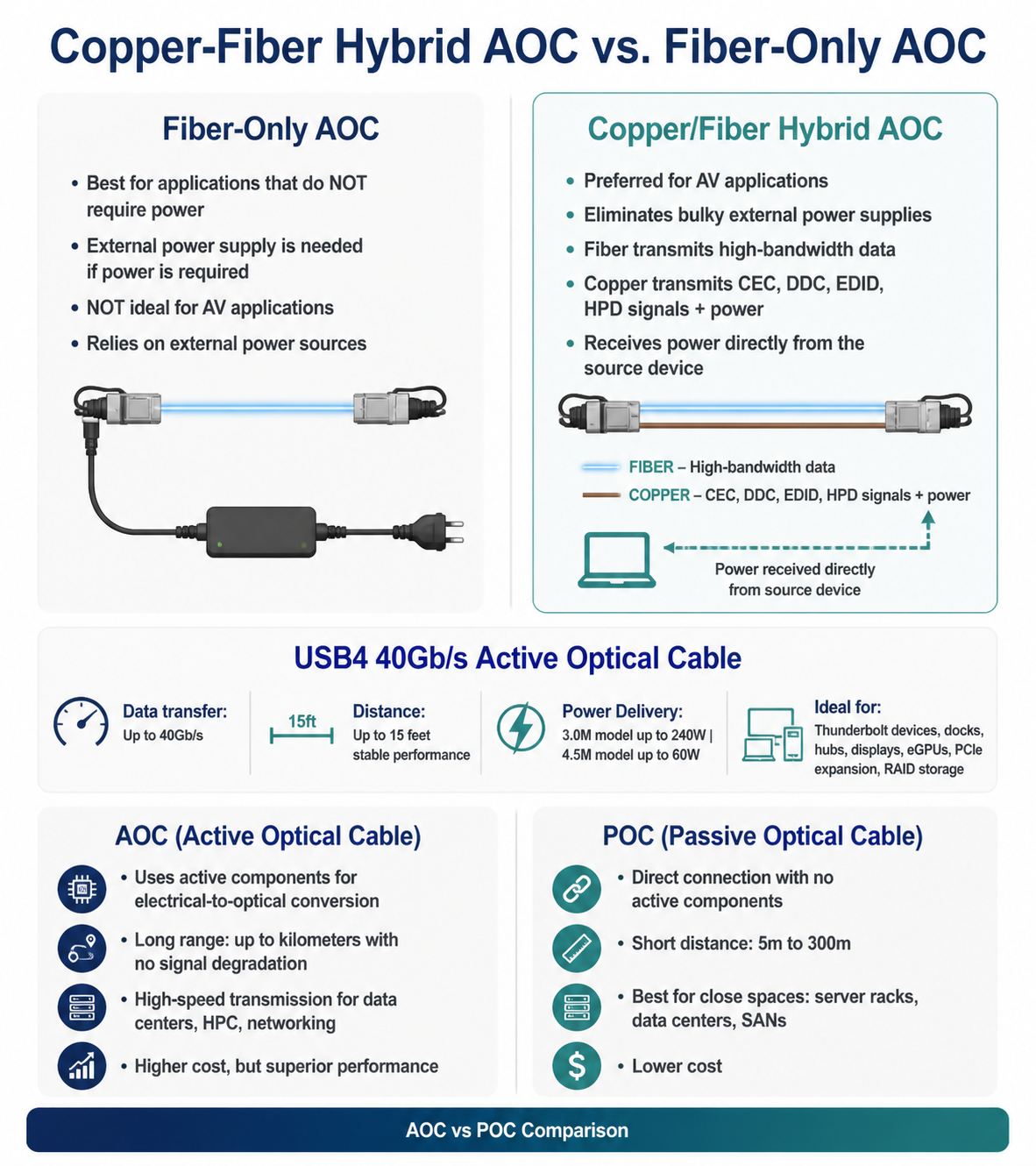
AOC Copper Fiber Hybrid vs. Fiber-Only Cable
Overview of Active Optical Cables (AOCs)
Active Optical Cables (AOCs) are advanced connectivity solutions that convert electrical signals into optical signals at one end and back to electrical signals at the other, using embedded transceivers within the connector housings. Unlike passive copper cables, AOCs can transmit data over significantly longer distances—often measured in kilometers—without signal degradation.
There are two primary variants of AOCs:
|
Feature
|
Fiber-Only AOC
|
Copper/Fiber Hybrid AOC
|
|
Construction
|
Pure optical fibers
|
Optical fibers + copper conductors
|
|
Power Delivery
|
❌ No (requires external power)
|
✅ Yes (over copper conductors)
|
|
Low-speed signals
|
❌ No copper path
|
✅ CEC, DDC, EDID, HPD over copper
|
|
Best Use Case
|
Data centers, long-haul networking
|
AV applications, consumer electronics
|
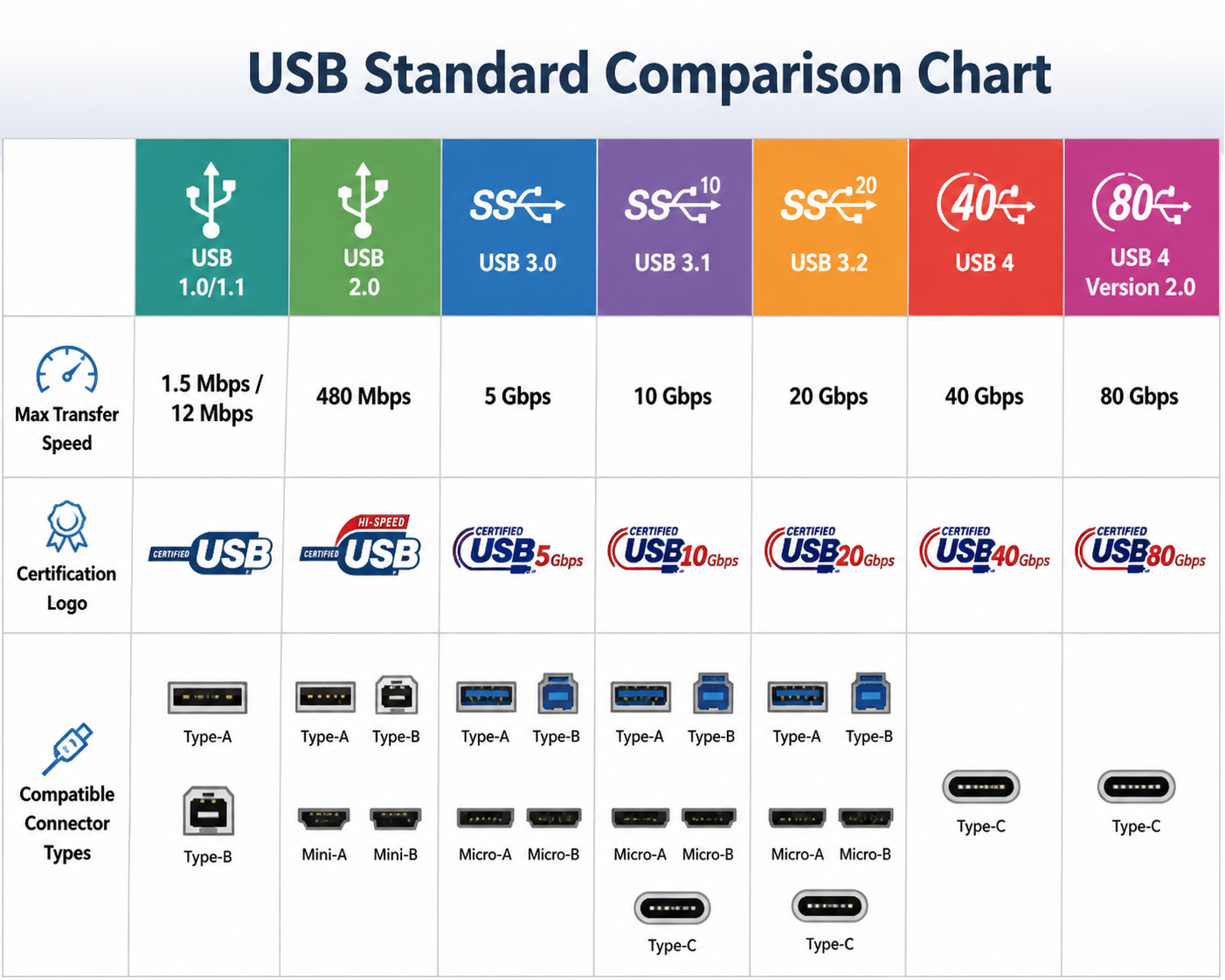
Generation of USB
The Connector Evolution
|
Connector
|
Shape
|
Introduced
|
Key Feature
|
|
USB-A
|
Rectangular
|
1996
|
The classic, one-way plug
|
|
USB-B
|
Square with bevel
|
1996
|
Printers & larger peripherals
|
|
Mini-USB
|
Smaller variant
|
Early 2000s
|
Older mobile devices
|
|
Micro-USB
|
Flat, compact
|
2007
|
Smartphones (pre-USB-C era)
|
|
USB-C
|
Oval, reversible
|
2014
|
The future — reversible, high power, high speed
|
USB-C is a game-changer: reversible plug design, supports up to 240W power, video output (DisplayPort Alt Mode), Thunderbolt, and all USB speeds up to USB4 v2.
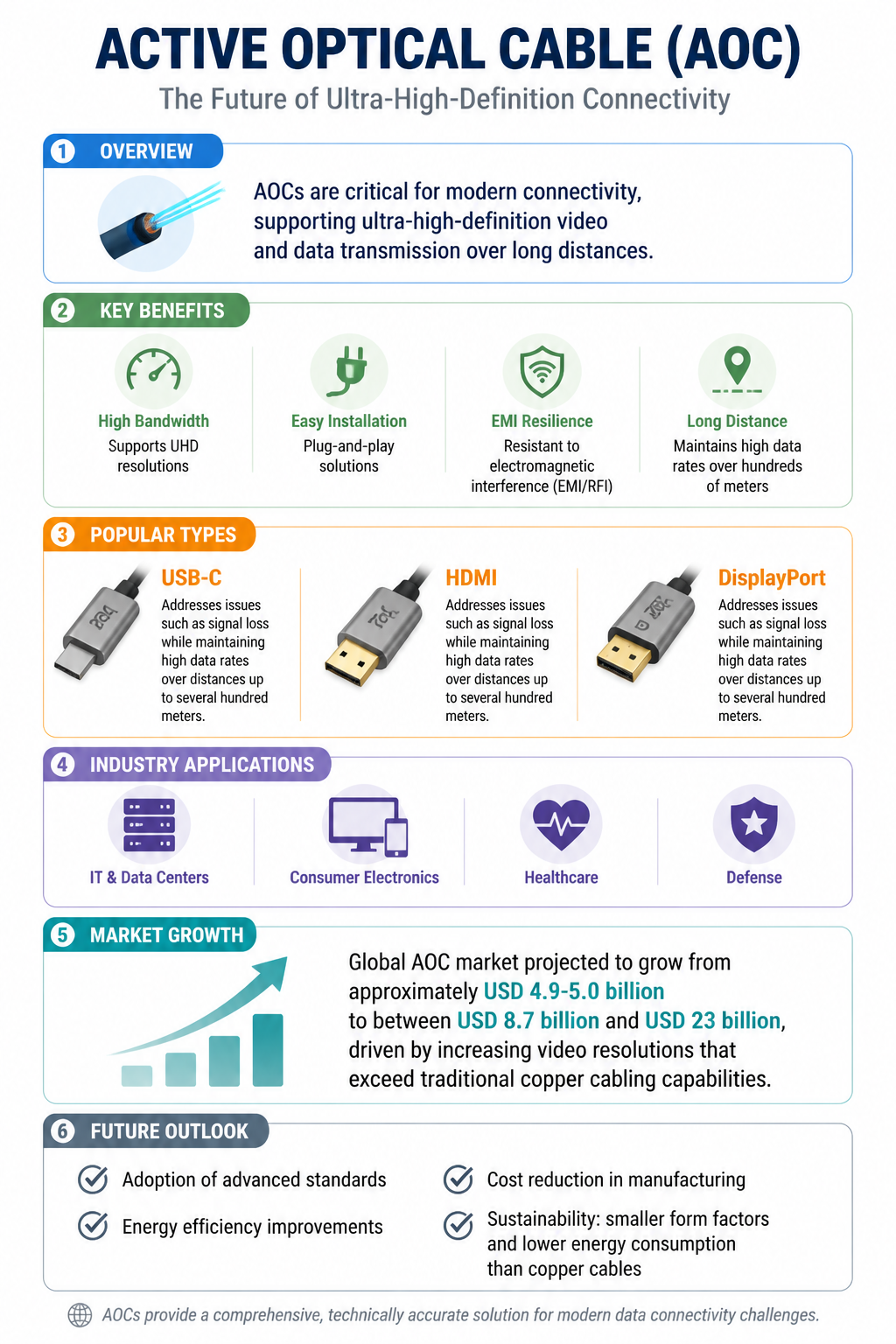
Conclusion on Active Optical Cables (AOCs)
1. Core Value Proposition (The "Why")
Active Optical Cables (AOCs) are pivotal in modern connectivity, especially for transmitting ultra-high-definition video and data over long distances. This is strongly supported by current market reality. The global AOC market reached approximately USD 4.9–5.0 billion in 2025, with a CAGR projected between 13.5% and 18.9%, reaching anywhere from USD 8.7 billion to USD 23 billion by 2034–2035 depending on the analyst firm.
The fundamental argument is economically sound: as video resolutions progress from HD → 4K → 8K, copper cabling becomes inadequate due to bulk, higher cost, and inflexibility. This is a decisive technical point — copper HDMI is known to degrade significantly beyond just ~10 meters, while AOCs maintain signal integrity over hundreds of meters.
2. Popular Product Categories
- USB-C AOC – Multi-functionality (data, video, audio, charging) with signal integrity over long distances; ideal for VR, machine vision, and data centers.
- HDMI AOC – Solves signal loss over extended ranges, essential with 4K/8K adoption where data rates have tripled compared to earlier HDMI standards.
- DisplayPort AOC – High-volume data transfer without degradation; allows high-speed transmission of data, video, and audio in bulk.
3. Future Outlook and Market Drivers
- Adoption of advanced standards — 400G AOC segments are poised to revolutionize AI and cloud computing, with LightCounting predicting 15% CAGR through 2028.
- Energy efficiency — A key differentiator given data center power demands.
- Cost reduction — As manufacturing scales, prices fall, driving wider adoption.
One nuance worth noting: market size estimates vary widely among analysts (from USD 8.7B to USD 86B by 2035), reflecting differences in scope (consumer vs. total). The consumer AOC segment specifically is growing even faster, at ~20% CAGR.
4. Sustainability & Responsible Development
This is increasingly important as AOCs offer advantages over copper by reducing material bulk, and their energy-efficient design supports sustainable data center operations. The call for balanced technological progress and eco-friendly development reflects current industry emphasis on sustainable digital infrastructure.